
Sunday, March 20, 2016

Thursday, July 11, 2013
Tuesday, September 22, 2009
Madison Courier Article | Worms lure some to try composting

Madison Courier, Madison, Indiana, on the Ohio River.
Thanks to worms, every day can be Earth Day. Every day a person can practice the ultimate recycling. Every day the vegetable scraps in the kitchen can be returned to the earth rather than rot in a landfill or take up space in a wastewater treatment plant.
Whether in a compost pile, a garden or a homemade compost bin, worms like to have a variety of foods, the right amount of water, no direct sunlight, and darkness. A little bit of dirt or sand to aid digestion, some used coffee grounds and a bit of paper - such as torn up newspaper - add more variety and comforts to their home.
In return, the worms help microbes break down what they've been given to eat. They aerate the compost when they crawl through it, which speeds composting, and leave behind their droppings, called castings, which add valuable nutrients to the compost.
Many compost piles naturally attract worms, but perhaps not enough for the amount of material to be composted, and when a compost pile is new it takes time to get a hungry bunch to show up. Worms can be purchased where bait is sold. The same worms that dangle from fishing hooks eat their way through a compost pile. As an extra benefit, worms can be plucked from the compost pile and used as bait.
Richard Sawyer of Sawyer Wholesale Bait Co. in Charlestown said customers buy worms for both purposes. Sawyers' family business has a retail store at 310 Market St., and the business is the wholesale supplier to retailers including in the Madison area.
When worms are bought for composting, he said, "most people use them in a leaf pile - grass and leaves, and they throw things like you put down the garbage disposal, leftover salad."
The salad should be without dressing on it, and vegetable trimmings that usually are put in the garbage or down the disposal such as celery leaves, outer lettuce leaves, carrot tops and similar kitchen discards, preferably uncooked, are perfect for worm food.
Sawyer sells a kind of worm called wigglers, which some people call drift worms. Wigglers in a cup - handy to take fishing - cost $2.50 for a cup of worms at Sawyer's in Charlestown. A square compost pile 3 feet on each side and 3 feet deep would need about 1,000 wigglers, he said. If neighbors went together for worms, they could buy a case of 5,000 worms for $300, or a half-case for $175.
Compost can be used as a soil conditioner or mulch indoors and out, on houseplants, garden vegetables, flower beds and lawns.
If compost with worms, called vermicompost, is made in a bin such as an old dresser drawer or wooden box, it will need to have drain holes in the bottom, and be set on bricks or boards so it can drain and so air can circulate. Plastic tubs or totes also can be used, but they tend to stay too wet if the drain holes are too few or too small. A container placed underneath the compost box or bin will catch the drainage, and it makes a good liquid fertilizer.
A compost pile doesn't need a cover if there is enough depth for the worms to seek darkness, but indoors a compost bin should have a cover such as burlap, loose enough to let air in but not so loose the worms will be able to go exploring.
There is some maintenance. The finished compost has to be removed regularly and used or stored in plastic bags. The worms have to be separated from the finished compost and given new materials to work on.
Separating the worms from the compost isn't as yucky as it might seem. Just stop putting in new material for about 10 days, pull aside the compost to be removed, clear a space for new grass, leaves, vegetables and paper, and watch the worms slide on over to the new chow spot.
Stragglers can be picked up with a stick for those too queasy to touch a worm, which doesn't bite and isn't poisonous, though it might give off a yellow liquid that is not urine and won't hurt anything.
When a compost pile or bin is new and worms are added, there's no need to worry about having the right number of males and females. All worms produce both eggs and sperm, so there is no male or female among them. When it's time to mate, they line up very close together and trade sperm. An egg pouch forms and baby worms emerge and start looking for something to eat.
People new to composting who don't want to chance using too little or too much vegetable matter and water can find a lot of information about composting online or at the library.
A compost pile doesn't have to have worms, but they hasten composting, add nutrients and aerate the dirt, and as long as they have food and water, they make every day Earth Day. Full Text Here

Thursday, April 16, 2009
Dunkin Donuts Solar Powered Worm Operations in FL
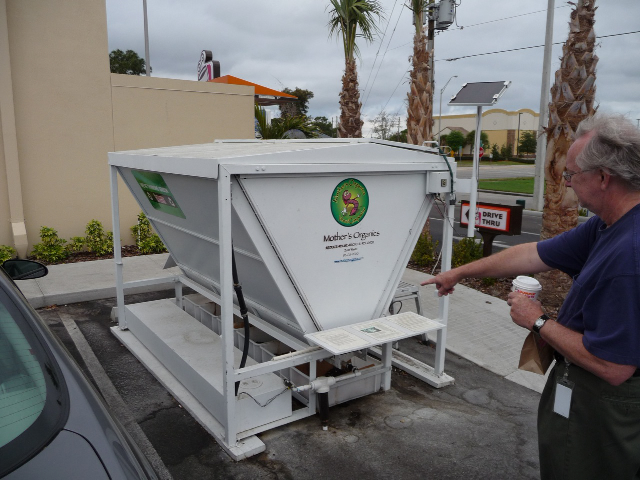
http://realneo.us/content/dunkin-donuts-have-some-worm-tea
CNN - Worms as Environmental Saviors !
....In Hong Kong, none other than fast-food chain McDonald's has signed up to a vermicomposting program that will have 80 million worms feasting on between 50 and 200 tons of organic waste a day, according to the Reuters news service. McDonald's aims to decrease the amount of waste it sends to Hong Kong's rapidly filling landfills by 80 percent, Reuters reports....
Full Text at:
http://www.cnn.com/2007/WORLD/asiapcf/10/22/eco.about.worms/#cnnSTCText
Full Text at:
http://www.cnn.com/2007/WORLD/asiapcf/10/22/eco.about.worms/#cnnSTCText
Monday, April 21, 2008
The Digestive Table

To keep your table clean of any leftover, one can either adopt the radical Katazukue way or turn to worms, sowbugs and bacteria for a more sustainable solution.
A wriggling and living ecosystem is invited to Amy Young's Digestive Table. After users have discarded food leftovers and shredded paper into the portal at the top, the bacteria and sowbugs begin breaking down the waste and the worms join in to further digest it into a compost that sprinkles out of the bottom of the bag that hangs beneath the table. This compost is used as a fertilizer for plants, such as those at the base of the table.
Seeing worms is difficult since the creatures are harmed by white light. They do not mind infra-red, but humans cannot see in that frequency. Therefore, Young has made a cross-section of the activity inside the compost visible using an IR security camera connected to an LCD screen built into the table. On the screen (image below), viewers can see the live movements of the worms and sowbugs inside.
The hand-made composting bag is based on a "flow-through" vermicomposting system, designed to make harvesting the worm castings much easier. Informative how-to handout, written by Amy Stewart can be downloaded here.
The wood is Forest Stewardship Council Certified oak plywood. They have a policy to "agressively phase out the purchase of wood products from endangered forests". In an effort to be ecological and to reference the cycle of food reprocessing, the wood was stained with a homemade concoction of boiled red cabbage, mixed with a little worm compost tea and alum.
Wednesday, March 12, 2008


Thursday, March 6, 2008
Tuesday, February 26, 2008


Friday, December 21, 2007
Grape Tomatoe Seeds For The Verms


market not to far from our home. In preparation for making some salsa these tomatoes were
deseeded. The seeds of course were frozen then added into the worm bin
at the next feeding time!
Sunday, September 2, 2007

Leading Edge Vermicomposters!

It's feeding time for the worms and the licensed compost operators are right on time.
Worms Around The Home!
 This is a close up of the worm bin during the feeding process. I feed my bin ever 2-3 weeks max. Th3erefore I put several points of food in at a time. Sometimes we bury the food in the bedding and castings.
Here see bananas, cucumber, pasta, etc. Note as we generated this organic waste we accumulated it in our home freezer. This helps the food break down, when it thaws, and kills any insect larva, etc on skins of bananas and so on. We freeze the stuff instead of using pesticides to fight the bugs. Using temperature like this and the consideration of non-chemical based methods to control nuisance species is called Integrated Pest Management or IPM. Typically IPM relies upon several types of controls to achieve desired outcomes. Chemical controls are one of the components but the whole point is to formalize the approaches to non-chemical methods. Structural controls, biological controls, mechanical controls, and predatory controls are also viable options. We'll talk more on this later.
 This is inside our current bin at home. Notice the hay from my yard. Also a Styrofoam black deli tray. The tray is used to help keep moisture in the bin during the winter. I need to work on moisture regulation.
Saturday, September 1, 2007
R2V Kick Off Party
The Rhodes 2 Vermicycling kick off party was coordinated on the schools side by Biology teacher Kim Swaggard. Here she is up on the mic getting the kids amped about the games of the day, as well as the upcoming worm project!

In the photo below you see students and the principal bobbing for worms. The worm dirt is chocolate pudding, and the worms are gummi worms. The person that pulled out the most gummi worms won 25$ gift card for the movies!

In this photothe unassembled bins have been distributed throughout the room. Students are assembling the simple ventilation system that help improve airflow in the bins. These vents are currently made out of pvc pipe. In the future we intend to phase that plastic out and replace the systems with abs or another more eco_preferrable material.


 Why is the word 'sustainability' up on the board? How does that apply to this project?

We all played worm jeopardy and did not even know that we were learning more about worms and the project thru the game !!!


In the photo below you see students and the principal bobbing for worms. The worm dirt is chocolate pudding, and the worms are gummi worms. The person that pulled out the most gummi worms won 25$ gift card for the movies!

In this photothe unassembled bins have been distributed throughout the room. Students are assembling the simple ventilation system that help improve airflow in the bins. These vents are currently made out of pvc pipe. In the future we intend to phase that plastic out and replace the systems with abs or another more eco_preferrable material.


 Why is the word 'sustainability' up on the board? How does that apply to this project?
We all played worm jeopardy and did not even know that we were learning more about worms and the project thru the game !!!

Load em up!
On the day the worms arrived from Florida, the students at James Ford Rhodes Highschool in Cleveland, Ohio unpacked, weighed out the worms, and put about a thousand in each of the bins!


 Two happy students eagerly feeding the bins. One is holding a salad chopper. The finer the food is diced up the faster it will be consumed by the worms!
 Thats the Plain Dealer photographer in the back, Amanda, 2 students, and our supporting teacher Kim Swaggard. You can see the bin racks of our big operation in the background!


 Two happy students eagerly feeding the bins. One is holding a salad chopper. The finer the food is diced up the faster it will be consumed by the worms!
 Thats the Plain Dealer photographer in the back, Amanda, 2 students, and our supporting teacher Kim Swaggard. You can see the bin racks of our big operation in the background!

The original 25 'bins a la cart'!
 This is a photo of the first order of bins. James Ford Rhodes rooftop greenhouse here we come.
Plain Dealer Article
 This photo was taken the the Cleveland Plain Dealer on the day the worms arrived. A press release was sent out. Templates are available. =-)
Thursday, August 30, 2007


Subscribe to:
Posts (Atom)
